If you’ve ever stared at a toll bill and wondered where the numbers come from, I-PASS toll rates can feel like a mystery. Your I-PASS login platform shows your balance, but it does not explain the math behind every charge.

In this guide, I’ll walk you through Illinois Tollway rates, the I-PASS passenger discount, and I-PASS vs Pay By Plate. We’ll break down electronic toll collection and give you a clear vehicle toll cost breakdown. Whether you’re a daily commuter or a weekend road tripper, this guide has you covered. Ready? Let’s dive in.
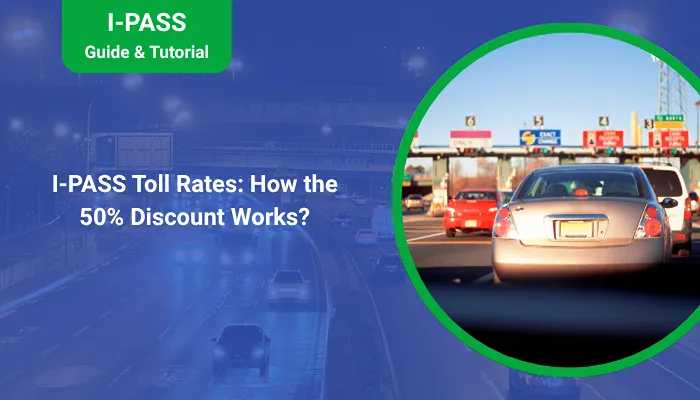
I-PASS Toll Rates: How the 50% Discount Works?
Here is the single most important thing I can tell you. The I-PASS toll rates you pay are exactly half of what everyone else pays, as long as you mount a transponder and keep your account funded. Let me repeat that. Half. The transponder discount rates are not a gimmick. They are the core reason I-PASS exists.
I remember the first time I drove from Wisconsin into Illinois without an I-PASS. I paid $1.90 at the South Beloit plaza. My friend with an I-PASS paid $0.95. Same road. Same car. Same distance. I felt like I had walked into the wrong restaurant and ordered off the tourist menu. Never again.
- The I-PASS app lets you monitor your balance in real time so you never get caught off guard by I-PASS toll rates.
- RFID video tolling is the technology behind the scenes. Overhead gantries scan your transponder instantly as you drive under them at highway speed.
- The V-Toll safety net is your backup. If your transponder fails to read, cameras capture your license plate and match it to your account.
- You get up to five V-Tolls per month per plate at the discounted rate. After the fifth, you pay the full cash rate for the rest of that month.
- This is why mounting your Illinois toll transponder properly is not optional. It is the difference between electronic toll saving and an unpleasant surprise.
- Pro tip: if your transponder is sitting on your dashboard instead of stuck to the windshield, you are basically asking for V-Tolls. Do not do that.
Understanding I-PASS toll rates means understanding one rule. A correctly mounted transponder keeps your discount alive. Everything else follows from there.
I-PASS vs. Pay By Plate: What You Actually Pay?
Let me save you the suspense. Pay By Plate charges you exactly double the I-PASS toll rates at every single plaza. Every one. There is no secret discount hiding somewhere on the online toll payment portal. If you drive without a transponder, you pay the Pay By Plate cost, and it stings.
I once recommended Pay By Plate to a friend visiting from out of state for a weekend. He paid $3.00 at Belvidere. I paid $1.50 on the same trip. He looked at me like I had betrayed him. Fair enough. I should have just told him to register his rental car on my account. Lesson learned.
Now, there is a scenario where Pay By Plate makes sense. If you are driving a rental car for two days and you will never touch a toll road again, maybe it is fine. But if you live here, or visit often, the math is brutal.
Here is the side by side comparison that made my friend wish he had listened.
| Toll Plaza | I-PASS Rate | Pay By Plate Cost |
|---|---|---|
| South Beloit | $0.95 | $1.90 |
| Belvidere | $1.50 | $3.00 |
| Waukegan | $1.40 | $2.80 |
| Touhy Avenue | $0.95 | $1.90 |
| DeKalb | $1.80 | $3.60 |
| Typical Ramp Plaza | $0.30 to $0.75 | $0.60 to $1.50 |
The Illinois video toll rate for Pay By Plate is not just slightly higher. It is the full unregistered toll fee rate. And if you forget to pay within 14 days, an additional $3 administrative fee gets added per toll. I have seen people turn a $0.60 ramp toll into a $3.60 bill just by waiting.
The I-PASS state coverage network also matters here. Pay By Plate only works on Illinois Tollway roads. It does not work on the Chicago Skyway. It does not work on the Indiana Toll Road. It does not work in other states. Meanwhile, I-PASS toll rates travel with you across 19 states, even though local authorities set their own prices.
If you drive on Illinois toll roads more than twice a year, get an I-PASS. The pay online vs transponder comparison is not close.
Passenger Vehicle I-PASS Rates Across Toll Plazas
Now let us get into the actual numbers. I want you to see exactly what you are paying at specific plazas so there are no surprises. The passenger vehicle toll tiers are straightforward for cars and motorcycles. You are Tier 1. You get the discounted I-PASS toll rates. The only question is which plaza you are passing through.
I drove the Jane Addams Memorial Tollway from Wisconsin down to Elgin last month and tracked every toll. It was eye opening. The I-90 I-PASS cost added up faster than I expected, but it still cost half of what my passenger would have paid without a transponder. That is the power of I-PASS activation done correctly.
Here are the current mainline and ramp rates as of early 2026.
- South Beloit on I-90: $0.95 with I-PASS.
- Belvidere on I-90: $1.50.
- Marengo-Hampshire on I-90: $1.50.
- Elgin on I-90: $0.75.
- Randall Road ramp: $0.55.
- Illinois 47 ramp: $0.45.
- Touhy Avenue on I-294: $0.95.
- Waukegan on I-294/I-94: $1.40.
- DeKalb on I-88: $1.80.
- Spring Creek on I-355: $1.90.
Ramp plazas are your best friend if you want to save money. Most ramp toll fees range from $0.30 to $0.75 with I-PASS. Those mainline toll plaza rates are the ones that hurt, which is why I always check whether a ramp gets me where I need to go.
Now, one corridor behaves differently. The Illinois Route 390 gantry tolls use distance based pricing instead of a single mainline charge. You pay per gantry, roughly $0.25 to $0.60 each. If you are on IL-390 for a short distance, you pay less. If you are on it for the full length, you pay more.
One more thing. If you see the term I-PASS simple floating around, do not overthink it. It usually refers to legacy or simplified account types. The important thing is that your account is active and your transponder is mounted. Then the I-PASS toll rates you were promised actually show up on your statement.
Commercial Vehicle I-PASS Discounts for Lower Toll Rates
If you drive a truck, a bus, or any vehicle with more than four tires, this section is for you. I have talked to fleet managers who did not realize how much the off-peak toll discount could save their operation. I have also talked to owner operators who were paying daytime rates for overnight runs because nobody told them the rules.
Commercial vehicles are divided into three tiers beyond passenger cars. The multi-axle vehicle tolls are based on axles and tires, not weight. That surprises a lot of people. And the I-PASS toll rates for these tiers swing wildly depending on when you drive.
| Vehicle Tier | Description | South Beloit Daytime I-PASS | South Beloit Overnight I-PASS |
|---|---|---|---|
| Tier 2 (Small) | 2 axles, 6 tires | $4.05 | $2.65 |
| Tier 3 (Medium) | 3 to 4 axles | $6.00 | $4.65 |
| Tier 4 (Large) | 5 or more axles | $10.60 | $7.95 |
Look at that overnight column again. A Tier 2 truck saves $1.40 per plaza just by driving between 10 p.m. and 6 a.m. Over a full run with multiple plazas, that adds up fast. This is the commercial truck toll rates structure working in your favor if you plan ahead.
Now, here is where I need you to pay attention. PrePass Plus Illinois is a game changer for fleets that need both weigh station bypass and toll payment in a single transponder. If you are running fleet tolling management across multiple vehicles, this is the tool you want. One device. Two jobs. Less paperwork.
The 30% commercial increase arriving in 2027 is going to hurt. I will not pretend otherwise. But the overnight discount remains in place, and the tier structure remains the same. If you can shift more runs to overnight hours, the overnight I-PASS toll rates will soften the blow considerably.
What is Changing With I-PASS Rates in 2027?
I have some news I wish I did not have to deliver. On August 19, 2026, the Illinois Tollway Board voted 8 to 0 to approve a change that starts on January 1, 2027. This is the first passenger increase since 2012. If you have been enjoying those low rates, enjoy them while they last.
I remember when I first moved to Illinois and saw that I-PASS toll rates averaged around 7 cents per mile. I thought someone had made a mistake. That is incredibly cheap compared to other toll systems. Well, the mistake was thinking it would last forever.
Here is what is changing.
- Passenger per mile toll rates rise from an average of 7 cents to 11 cents. That is a 57 percent jump.
- A toll that costs $0.75 today becomes $1.20 with I-PASS starting January 1, 2027.
- The same toll without I-PASS jumps from $1.50 to $2.40. Yes, Pay By Plate users pay double the new rate.
- Commercial vehicle rates increase by 30 percent.
- Beginning in 2029, I-PASS toll rates will adjust every two years based on inflation, tied to the Consumer Price Index.
- The Illinois Tollway Board decision funds a $26.5 billion capital program called Driving Connections.
I know what you are thinking. Another 2027 Illinois toll rate hike. Another bill. I get it. This tollway price increase is real, and it is coming. But here is the practical reality. Even after the change, Illinois rates remain below the national average of 16 cents per mile. That does not make it painless, but it does put it in perspective.
If you have been putting off I-PASS registration, do it now. If you are already registered, check your I-PASS payment method and confirm your auto-replenish I-PASS settings are correct. The last thing you want is a declined card turning your discounted tolls into full rate I-PASS pay by plate invoices. Keep an eye on 2027 I-PASS updates so nothing catches you off guard.
How to Calculate Your I-PASS Trip Cost?
Let me be honest with you. Guessing your toll cost is a terrible strategy. I used to do it, and I was wrong every single time. Then I discovered the Illinois Tollway trip calculator, and my life got a whole lot easier.
Whether you are planning a daily commute or a one time road trip, this tool removes the guesswork. I will walk you through exactly how to use it, step by step, so you can budget with confidence.
Step 1: Open the Route Toll Planner
Head to the official Illinois Tollway website or open the I-PASS app. Look for the route toll planner feature. This is your starting point. Do not skip it. I know it is tempting to just drive and hope for the best, but hope is not a financial plan.
Step 2: Enter Your Start and End Points
Type in where you are leaving from and where you are going. You can also click directly on the map if that is easier. The system will map out every toll plaza along your route. This is where the magic begins.
Step 3: Select Your Vehicle and Payment Details
Choose your vehicle class. Are you in a passenger car? A commercial truck? Pick your payment type. If you have an active I-PASS registration, select that. The calculator will show you the discounted I-PASS toll rates. If you are paying by plate, it will show you the full rate. Trust me, you want the discount.
Step 4: Review Your Commute Toll Estimate
Click the button to generate your route. Scroll down and look at the total. This is your commute toll estimate for the trip. You will see each plaza name, the plaza number, and the exact toll amount. I always screenshot this before a long drive. It keeps me from being surprised.
Step 5: Calculate Your Per Mile Toll Cost and Savings
Divide the total toll by the number of miles you are driving. That gives you your per mile toll cost. Now compare it to what you would pay without I-PASS. The difference is your savings. You can even use this as a simple I-PASS savings calculator for your regular commute.
If you ever get a notice for I-PASS violations, go back to this tool and verify the charges. Sometimes mistakes happen, and the calculator helps you spot them. And that is it. Five steps. Less than two minutes. You now know exactly what your trip will cost, and you can see the gap between I-PASS toll rates and Pay By Plate rates in black and white.
Conclusion
So there you have it. I-PASS toll rates reward drivers who mount a transponder, keep a funded account, and plan ahead. We covered the 50% discount, the Pay By Plate penalty, commercial tiers, and the 2027 changes.
If you want the cheapest Illinois toll option, the answer never changed. Enjoy the I-PASS sticker tag benefits, set up auto-replenish I-PASS so a declined card never bites you, and lean on the official Illinois Tollway guide before every long trip. Do that, and your travel toll savings add up quietly, month after month.